Adam Sosnick says 4 million professional drivers' jobs may not last much longer
The PBD panel turned Elon Musk's Tesla Semi pitch into a warning shot for truckers, Uber drivers, and anyone paid to sit behind a wheel.
Listen on YouTube
 WATCH NOW↓
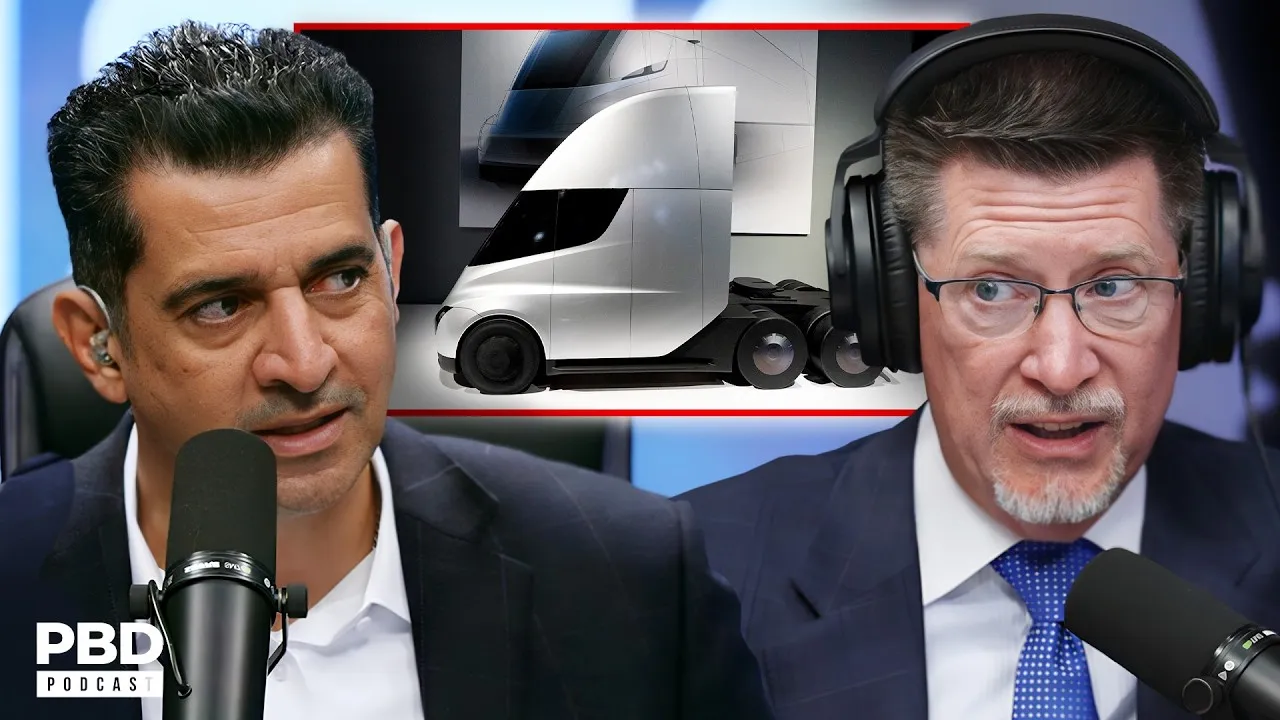
 Adam Sosnick’s takeaway from Elon Musk’s Tesla Semi rollout was not that the truck looks slick. It was that roughly 4 million professional drivers should stop acting safe, because their jobs may not last much longer.
That is the real charge inside this PBD Podcast segment. Yes, Elon Musk is there by video, selling the electric vehicles dream in full carnival-barker engineer mode, 500 miles loaded, mega-charging, cheaper energy per mile, fun to drive. But Adam Sosnick hears something else underneath the sales pitch: not a truck launch, a labor-market warning.
এটি অনেকটা ট্রাকের আকারে একটি স্পোর্টস কারের মতো।
That line is classic Musk. Make the machine sound inevitable, then make it sound fun. A semi truck as a sports car is absurd in the way only Musk product language can be absurd, but it also reframes freight as consumer tech. Not a diesel workhorse. A gadget with torque.
The spreadsheet is the sales pitch
Patrick Bet-David’s panel does not treat the Semi as a green halo product. They treat it as a cost knife. The important audience is not a guy yelling in the live chat that nobody wants EVs. It is Walmart, DHL, PepsiCo, and the fleet CFO staring at diesel prices like the numbers personally insulted his mother.
ডিজেল জ্বালানির খরচ প্রতি মাইলে প্রায় ৮০ সেন্ট, যেখানে বিদ্যুতের খরচ প্রতি মাইলে ২০ থেকে ৩০ সেন্ট।
That is why the anti-EV reflex runs out of road here. If a truck can do the route, charge at the depot, and save meaningful fuel money, nobody in the C-suite needs to feel spiritually moved by a battery. They just need the math to behave.
Tom Ellsworth adds the ugly middle layer, the one that never fits inside the launch event. Big fleets can build charging infrastructure. Smaller trucking companies cannot casually drop chargers everywhere and call it innovation. He also describes an unnamed Chicago trucking business whose EBITDA got hammered by fuel costs, a reminder that diesel inflation is not an abstraction when your trucks are financed and the bank knows where they sleep.
Sosnick hears a layoff siren
Then Sosnick takes the logic from fleet economics to human economics. He brings up talking to an Uber driver and gives the advice nobody wants from the back seat of a rideshare.
তোমার এখনই একটা নতুন চাকরি খোঁজা উচিত, ভাই।
Subtle, no. Useful, maybe. Sosnick is bundling several threats into one ominous package: autonomous taxis, autonomous trucking, and the Tesla Semi’s promised self-driving features. That makes the prediction more dramatic than the current reality. A truck that can assist a driver is not the same thing as a national fleet of robot rigs hauling freight through snow, construction zones, weigh stations, bad GPS, and lawyers.
But the warning is not empty theater. Driving has always looked safer than other jobs because it is physical, local, and everywhere. The PBD segment argues that those qualities may be exactly why the job category is such a fat target for autonomous vehicles. If you move people or freight for a living, software does not need to replace every mile to make your bargaining power worse. It only needs to replace the profitable miles first.
The fair verdict: Sosnick’s timeline is hazy and his tone is pure alarm bell, but the career advice is less crazy than it sounds. Do not assume the steering wheel is a pension plan.
আমার মনে হয়, প্রায় ৪০ লক্ষ পেশাদার চালক আছেন। ২০ লক্ষ বড় ট্রাক চালান এবং ২০ লক্ষ অন্যান্য ধরনের যানবাহন চালান। আপনার চাকরি হয়তো আর বেশিদিন টিকবে না।
- Did Adam Sosnick say Tesla Semi will replace truck drivers?
- Sosnick did not say the Tesla Semi alone will wipe out trucking jobs tomorrow. His bigger warning was that autonomous vehicles, from Waymo-style robotaxis to self-driving freight, are coming for the whole driving economy. He put the at-risk pool at about 4 million professional drivers, split between big-rig drivers and other transportation workers.
- Why did the PBD panel think fleet operators care about Tesla Semi?
- The argument was brutally financial. The panel cited diesel at roughly 80 cents per mile versus electricity at 20 to 30 cents per mile, which is the kind of spreadsheet line that makes a fleet CFO forget every culture-war rant about EVs. Big companies can also install depot charging, while smaller trucking firms may struggle to afford the infrastructure.
- Is the warning about 4 million drivers believable?
- As a near-term prediction, it is too dramatic. Long-haul autonomy still has to deal with weather, insurance, liability, charging, state rules, loading docks, and all the annoying real-world stuff that ruins demos. As a career warning, though, Sosnick is not being silly. The pressure on paid driving jobs is real, even if the timeline is slower than the podcast alarm bell suggests.
Adam Sosnick says the Lindsay Clancy case is the new prenup
The PBD panel turned the Clancy mistrial into a brutal dating question, and the answer they want is not subtle.

Adam Sosnick says a couple is suing a surrogate for $600,000 because their son with a cleft lip is alive
The PBD panel framed an Ontario surrogacy lawsuit as the nightmare version of designer-baby logic, but the legal story is messier than the moral one.
Patrick Bet-David says the Pepsi jet lawsuit guy finally got 7 million Frontier miles
Frontier turned John Leonard's impossible Harrier jet prize into a Super Bowl bit, and the PBD crew correctly clocks the real winner, the airline's marketing department.
Patrick Bet-David says a $300,000 AI UBI would make most people miserable
A Ford AI quality-control story turned into Bet-David’s bigger anti-utopia: money without resistance is not freedom, it’s spiritual mush.
The circuit, read weekly. No noise.