Caleb Hearon Says Improv Saved His Life, and He Means It Literally
The comedian behind one of the best HBO specials in recent memory sits down with Mike Birbiglia and ends up somewhere much more honest than either of them planned.
Listen on YouTube
 WATCH NOW↓
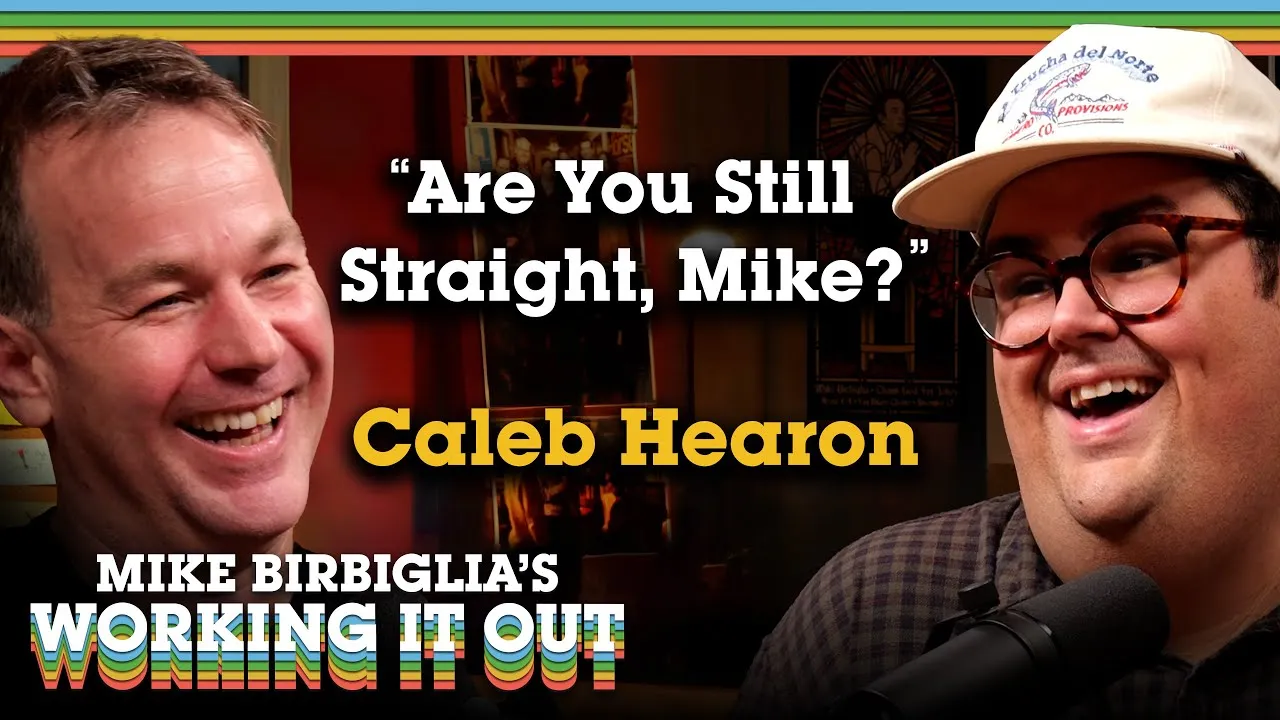
 Caleb Hearon walks into Mike Birbiglia’s podcast and immediately starts workshopping the idea that Birbiglia might not actually be straight. ‘Life is long and things are,’ he offers, gesturing at the universe. Birbiglia confirms: straight, married seventeen years. Hearon nods and pivots to the real critique. ‘I think you could have a gayer haircut.’ Which is funnier, more useful, and probably more true.
This is the register Hearon operates in: warm, specific, disarmingly sincere, and then suddenly sharper than you were ready for. He’s been doing it on his podcast for long enough that strangers treat him like a friend they haven’t seen in a while, which he says he genuinely prefers to being screamed at. He’d rather be greeted normally. He’d love to feel normal. He’s working on it.
Either Kill Yourself or Find a Way to Deal With It
Birbiglia notes, gently, that Hearon’s HBO special is called something like a happy special, and also contains extended material about suicidal ideation. How do those coexist? Hearon doesn’t bother pretending the question is complicated.
There just gets to a point where you’re like, okay, then either kill yourself or find a way to deal with it. And so you just find a way to deal with it, you know? Or you don’t. And then it’s the other thing.
He says it without drama. Birbiglia asks what the other thing is. ‘Suicide.’ Beat. ‘We’re supposed to say it hushed.’ The laugh that follows is real, and earned, and not a deflection. This is exactly what Hearon is good at: making the audience feel the weight of a thing by refusing to perform the weight of it.
When he talks about what pulled him through, he doesn’t give therapy or medication or a single revelation. He gives improv. Not metaphorically.
Improv changed my life, probably honestly saved my life. I think it makes you more present. I think it makes you a better conversationalist. It’s all about noticing and paying attention. And I think truly being happy is about noticing and paying attention.
He trained at iO in Chicago, which the transcript helpfully explains used to stand for Improv Olympic before a copyright dispute. He did SNL auditions twice, didn’t get it, and is genuinely glad about that in a way that sounds considered rather than cope. Steve Higgins told him during the pre-audition drinks that he should be making internet videos. He didn’t want to. He did it anyway. The rest of the decade went from there: quit his day job in January 2020, started driving Uber Eats during the pandemic, moved to Los Angeles anyway because he’d said he would, got his first TV writing job over Zoom. His dad died in 2022. He bought a house in Kansas City. He moved to New York a year ago. Wild five years is an understatement.
Among the Cards
Birbiglia’s jealousy question, a recurring segment on the show, gets the most interesting answer Hearon could have given: his friend Katie Crutchfield, who makes music as Waxahatchee. Not a comedian. Not a peer in any competitive sense. He’s jealous of her ability to step back and see a situation clearly, to have the cards laid out in front of her. ‘Sometimes I’m so in it that I feel like I’m among the cards,’ he says. Birbiglia recognizes it immediately. Two guys sitting across from each other, both being shuffled.
Hearon also tells Birbiglia that he used to believe, firmly, that he was a person incapable of being truly happy. He doesn’t say this like it was a phase. He says it like a man who tracked the exact error in his thinking and corrected it. ‘Happy people are sometimes sad and sad people are sometimes happy. It’s not a type of person. It’s a thing that you feel.’ The sentence lands differently coming from someone who just described the other fork in the road a few minutes earlier.
The Rat
After all of that, the episode ends with Hearon describing, in excruciating and genuinely nauseating detail, the time he reached into a pool with his toes, then his hand, and came up holding a waterlogged dead rat directly in front of his face. He workshops some half-baked premises from his notes app. He and Birbiglia collaboratively imagine what it would take to forgive a man who threw a vape cartridge into a bed of tulips when a trash can was three feet away. They plan a future life together in the mountains with Waxahatchee, the Mountain Goats, a long outdoor table, and autumn trees overhead.
What I daydream about? Peace. These two guys daydreaming about peace all day every day.
The thing about Hearon is that the rat story and the suicidal ideation and the jealousy and the improv manifesto are all the same conversation. He’s not compartmentalizing. He found a way to deal with it. This is what that looks like.
Michael Che Finally Shows Up for Mike Birbiglia's Podcast, Five and a Half Years Later
Two comedians who actually trust each other spend an hour workshopping bits, diagnosing SNL, and accidentally conducting therapy.
Bill Maher says he was “particularly bad” at blaming audiences when his jokes bombed
On Club Random, Maher turns a comedy cliché into a little self-indictment, while Lisa Kudrow offers the healthier, actorly version of bombing.
Joey Diaz says 19 years off cocaine gave him more than his first 44 years
Diaz turned a filthy, funny hang with Theo Von into a blunt sermon on sobriety, regret, and what finally showed up after the bag left.
Rahul Jandial says acting out your dreams can warn of Parkinson's 15 years early
The neurosurgeon’s strongest claim is not that dreams are mysterious, it is that some dream behavior belongs in a sleep clinic, not a dream dictionary.
The circuit, read weekly. No noise.